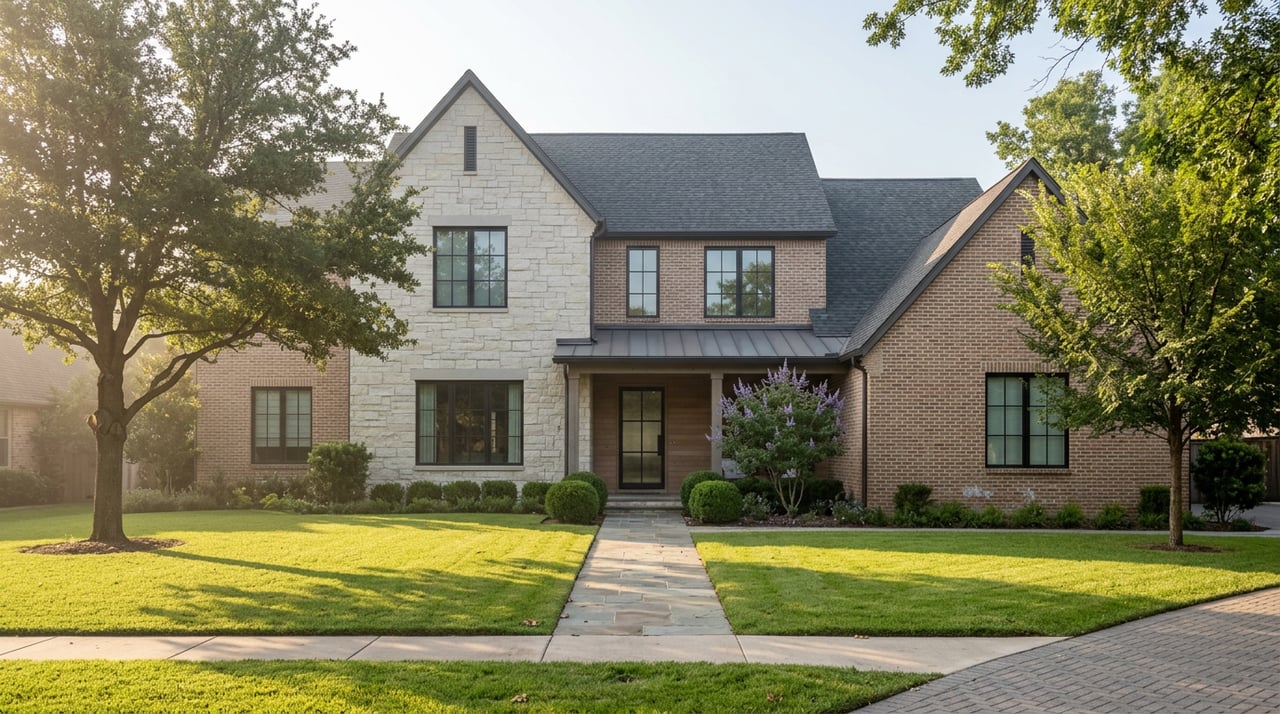
The Line Over Southlake That No Disclosure Form Will Show You
August 13, 2026
August 13, 2026
"We also make homeowners sign a form so that they know where the aircraft are and what to expect."
That line comes from Pamela Muller, a former Southlake City Councilwoman who had spent more than 25 years working on the city's aircraft noise program as of the interview in which she said it. She said it in the context of a decades-old agreement between Southlake and DFW International Airport, one that put a specific kind of paperwork in front of certain Southlake buyers long before "disclosure form" ever entered the conversation.
Most Southlake buyers never see that paperwork mentioned anywhere on the standard Texas Seller's Disclosure Notice. It is not a defect. It is not a repair history. It is a recorded interest in the land itself, and it lives in a different document entirely.
Southlake sits close enough to DFW International Airport that the city has spent decades negotiating how aircraft use the airspace above certain neighborhoods. The City of Southlake's own page on the subject lays out the mechanics plainly: a corridor over the city was established in the 1980s to guide land use decisions and reduce the impact of aircraft noise, tied to how planes use the west diagonal runway. Aircraft take off and land into the wind, so the direction of operations shifts with weather rather than staying fixed on a map.
The city states it directly: any residential development within that corridor built since the late 1980s carries what is called an aviation easement recorded on the property deed, acknowledging that the home sits inside the air corridor utilization zone. That single sentence is the whole story most buyers never hear until they own the house.
Here is where the obvious assumption falls apart. A buyer might reasonably think that homes under a flight path all carry this easement, and homes outside it don't. Location alone does not settle the question. The date on the deed does.
The corridor itself dates to the 1980s, and according to the city, the easement attaches specifically to development built since the late 1980s. That means two houses a few streets apart, both technically inside the same noise corridor, can have entirely different answers to the question "is this on my deed." One might predate the corridor's formal recognition. The other might have been platted the following year. A buyer cannot resolve this by asking which subdivision a home sits in. It has to come from the title record for that specific address.
That distinction matters across every price point in Southlake, not just the newest construction.
| Neighborhood | General character | The question worth asking |
|---|---|---|
| Timarron | Established country club community with mature landscaping | Confirm the build era against the late-1980s threshold with a title search |
| Carillon | Newer construction with tighter architectural controls | Later builds are more likely to fall inside the window the city describes |
| Stone Lakes | Established, wooded, mature tree canopy | Age alone doesn't answer it, the deed does |
| Southlake Woods | More accessible entry point for families | Same logic applies regardless of price point |
| Villas of Southlake | Most affordable single-family access in the city | Same logic applies regardless of price point |
The price tag tells a buyer almost nothing about whether this line item exists on their specific deed.
Texas sellers of previously occupied single-family homes complete a written disclosure under Property Code Section 5.008, using either the state's bare-bones TREC form or the more detailed Texas REALTORS version. According to the Texas REALTORS legal FAQ on the topic, both forms satisfy the statutory requirement, and the content runs through categories like roof condition, foundation history, plumbing, electrical systems, past flooding, and environmental hazards such as asbestos or lead paint. Homeowner association dues and special district assessments get their own line items too.
None of that checklist asks whether the airport has a recorded right to fly over the roof. The form is built to catch what a seller personally knows about the physical condition of the house and its systems. An aviation easement is neither a defect nor something most sellers think to volunteer, because nothing on the form prompts them to.
The easement does not disappear just because the disclosure form skips it. Aviation easements are recorded property interests that run with the land, which means they transfer automatically to each new owner and show up in a title search the same way any other recorded easement would. That makes the title commitment, specifically its schedule of exceptions, the document that actually surfaces this, not the seller's personal disclosure.
Most buyers glance at that exceptions list during the option period without reading each line closely, assuming it's boilerplate about utility easements and mineral rights. In Southlake, it is worth asking the title company directly whether an aviation or avigation easement appears in Schedule B before that option period runs out. This is a five-minute question that costs nothing and closes the exact gap the disclosure form leaves open.
Southlake's agreement with the airport was never one-sided. Muller described the city's approach: "We also make homeowners sign a form so that they know where the aircraft are and what to expect." In exchange for aircraft holding to the center line of the corridor, the city required enhanced building standards, including noise insulation, for construction within the zone. That means a home carrying this easement may also carry a level of sound insulation that homes outside the corridor never needed.
That trade-off rarely gets mentioned alongside the easement itself. A buyer weighing the two should ask about both sides of it, not just the existence of the recorded interest.
The corridor is not a fixed line drawn once in the 1980s and forgotten. Southlake's own history shows how much runway usage can shift year to year: aircraft noise complaints in the city escalated between 2012 and 2013 as wind patterns pushed more departures onto runway 31L, and the city responded by budgeting in 2014 to join the National Organization to Insure a Sound Controlled Environment and by adopting a Master Land Use plan built around current flight patterns, a step the city reported at the time as unique among that group's member communities. DFW Airport continues to run a Noise Compatibility Program today, with live flight tracking available through NoiseLab and a dedicated noise hotline for residents.
A buyer touring a Southlake home on a quiet afternoon is not necessarily seeing the full picture. Runway usage shifts with wind, maintenance schedules, and airport operations, which is exactly why the recorded easement exists as a permanent document rather than a snapshot that could go stale within a season.
Does an aviation easement show up on the Seller's Disclosure Notice? No. The statutory form is built around structural and environmental conditions. An aviation easement is a recorded property interest, and it typically surfaces on a title commitment rather than a disclosure notice.
If my deed has this easement, can I have it removed? These easements run with the land, transferring to each new owner by design. Removing one would require the cooperation of the easement holder, which in this case involves the airport authority, not a simple title correction.
Does the easement affect what I can build or renovate? The city has required enhanced building standards, including noise insulation, for construction within the corridor. Any significant renovation or new construction on an affected property should account for those standards from the start.
How do I find out if my specific address carries this easement? Ask your title company to check Schedule B during the option period, or review the deed history for the property directly. Neighborhood name and price point do not answer this question. The construction date and the recorded document do.
Is this the same as a flood zone or HOA disclosure? No. Flood zone status and HOA obligations appear directly on the standard disclosure form. An aviation easement does not, which is precisely why it requires a separate, deliberate check.
A recorded easement is not a red flag by itself. It is a detail that deserves the same scrutiny as any other line on a title commitment, especially in a city where the line was negotiated house by house, decade by decade, between a growing suburb and one of the busiest airports in the country. Buyers and sellers navigating that history deserve a team that reads the exceptions page as carefully as the listing photos.
If you're buying or selling in Southlake and want a second set of eyes on what's actually recorded against a property, The Texas Bespoke Realty Group can walk through the title commitment with you before your option period runs out. Contact us to start that conversation.
Stay up to date on the latest real estate trends.

Buying, selling, relocating, or investing—we're committed to making your experience effortless. With proven expertise and strategic guidance, we help you achieve the best possible outcome.

The Texas Bespoke Realty Group
(214) 674-8257
[email protected]
Address
4131 N. Central Expressway, Ste # 900
Dallas,TX 75204